The magazine "This England" honoured me by posting one of my stories in their 2016 Annual
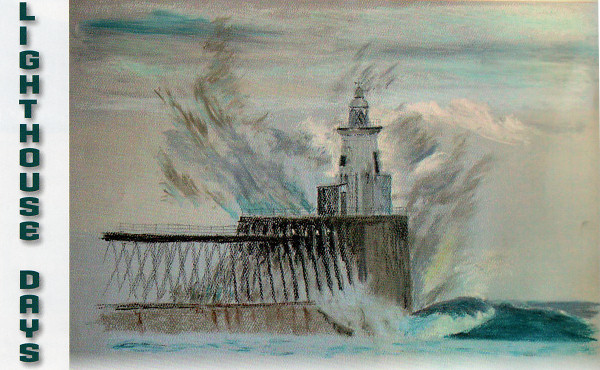
Even included a couple of my paintings
|
|||
 t was just after the second world war and I must have been about eight years old. My father and mother announced that we were going to visit my grandfather (Mum's father) at the lighthouse. My grandfather was a captain in the Merchant Marine in the first world war. Now retired, he had been asked to be lighthouse keeper at our local lighthouse on a shift basis. He worked four days on and four off staying at the lighthouse while on duty. t was just after the second world war and I must have been about eight years old. My father and mother announced that we were going to visit my grandfather (Mum's father) at the lighthouse. My grandfather was a captain in the Merchant Marine in the first world war. Now retired, he had been asked to be lighthouse keeper at our local lighthouse on a shift basis. He worked four days on and four off staying at the lighthouse while on duty.The lighthouse is at the end of a long pier which runs along the north side of the river Blyth in N.E.England. We lived on the south side of the river so it meant we had to get the Chain Ferry across and that pleased Les (my older brother) and me because we loved the "Chain Ferry". This was basically just a floating section of road which pulled itself back and forth across the river on steel cables onto ramps at each side. I suppose that in some time past steel cables had replaced the original chains but its name remained. We always hoped that a ship would be coming through because the ferry would pull itself right up the ramp and then release the cables to the bottom of the river to allow the ship to pass. I am sure, looking back, that the other people using the ferry were not nearly as pleased about ships passing as we were. We often saw the Milk man taking his horse and cart on to the ferry and marveled at how calm the horse was considering there was only a piece of rope between it and the river while the ferry chugged across. Alas this day was a Sunday and the ferry was not working but my dad, who knew everything, had found out that there was another ferry that worked Sundays So off we set on a nice day in February. "Nice" in the north-east of England meant it wasn't raining... yet. We walked through the park to the docks and under the staiths on the coal jetty. For those of you unfamiliar with shipping in the 40s staiths were a large wooden structures |
with a railway line on top.
The coal trains would tip their cargo down open shoots into the holds of waiting ships. To say that the docks were not clean would be a large understatement. If you can imagine how much coal dust is spread around when thousands of tons of coal are tipped down a shoot, that is what we were walking into. I never noticed it and neither did my brother but Mum made a few comments that made me take note. Her voice was rising as she mentioned to my dad that she was wearing her best coat and hat. I don't remember what he said. The adventure was just beginning and I was thrilled that we were at the main docks where we were not normally allowed, - but where was the ferry? Mum asked the same question and it was then that dad took us to the edge of the jetty. We looked over and saw a fisherman snoozing in a rowboat tied to the iron ladder which was part of the jetty. Dad said this was the ferry and I'm sure my brother and I whooped for joy. Mum's voice was a little higher I noticed but then I realised that she was old (over 40 at least) and with high heels it could be a little difficult getting to the boat since it was low tide and the water was about 15 feet down. We climbed quickly down into the boat and watched as Mum slowly accomplished the task. To give her her due it couldn't have been easy because you had to back up to the edge of the jetty, bend down and grasp the two hand holds and then step off blindly to find the first rung of the ladder. Finally we were all settled with Les and me in the stern and Mum in between us. Dad was in the bow of the boat. The large old fisherman sat in the center facing us and started rowing out into the river. I remember feeling bad that we were all sitting there doing nothing while this poor man heaved on the oars but he was a powerful chap and soon had us to the other side although I did notice Mum had become really quiet as the boat smashed through the small two foot swells. |
||
| 16 THIS ENGLAND'S ANNUAL 2016 TURN PAGE |